One City. One Problem.

Episode 04 | Utility asset management

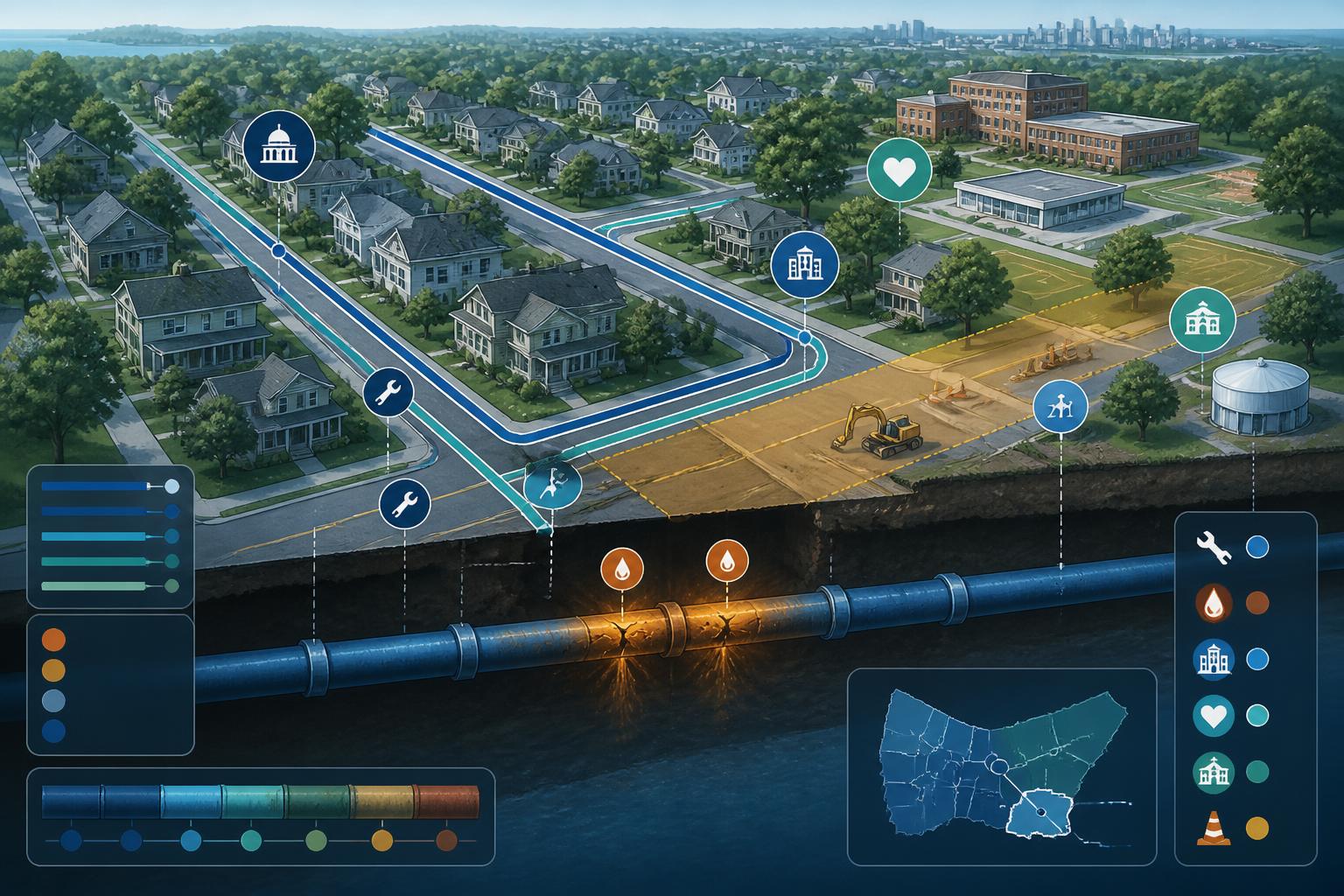
The Water Main That Keeps Breaking

Repairing the leak is urgent. Deciding what comes next is strategic.

Repairs keep restoring service, but not confidence. What evidence helps a utility decide where to investigate, rehabilitate, or replace next?

Date
Wednesday, December 9, 2026
Time
1:00 – 2:30 PM ET
Duration
90 minutes, virtual
Reserve your seat
Illustration for The Water Main That Keeps Breaking

The situation

One district has experienced repeated main breaks, emergency repairs, service disruptions, pavement damage, and growing public frustration. The utility has work-order history, pipe attributes, pressure information, field observations, and a finite capital budget.

But age alone does not explain failure — and replacing the wrong segment carries its own cost.

The decision

Should the utility monitor, investigate, rehabilitate, or replace — and what evidence makes that recommendation defensible?

Three expert contributions

Three disciplines, one shared decision node

01

Failure history and asset evidence

What can the utility learn by connecting work orders, pipe characteristics, location, environment, and consequence?

Show how to improve and combine imperfect records, distinguish symptoms from patterns, and identify the questions that the data cannot answer alone.

02

Condition and operational investigation

What targeted field or operational evidence would most improve the decision?

Show how inspection, monitoring, pressure analysis, leak intelligence, soil or site context, and field verification can test likely failure drivers.

03

Capital prioritization and intervention

How should the utility compare intervention options and prioritize this main against other needs?

Show how likelihood, consequence, lifecycle cost, coordination opportunities, equity, and service impact inform a transparent recommendation.

What the roundtable will test

  • What must happen first?
  • What evidence is good enough to make a decision?
  • Where do workflows or data need to connect?
  • What can be done now, and what requires a longer program?
  • How should the city explain the recommendation to leadership and the public?

Roundtable prompt

Another break occurs tomorrow. What immediate response, 90-day investigation, and capital decision should happen in sequence?

You will leave with

  • A three-step decision path
  • A clearer view of roles and dependencies
  • Questions to ask internally and of potential partners
  • A concise event recap and resource sheet

Three-step takeaway

  1. 01Build the failure story from connected evidence.
  2. 02Investigate the variables that could change the decision.
  3. 03Select and explain the intervention using risk and lifecycle value.

Audience takeaway asset

Repair-or-Replace Decision Card

Evidence, consequence, options, coordination opportunities, and recommendation.

The 75-minute format

  1. 01 · 10 minutes

    The problem

    The moderator introduces the city, the stakes, the constraints, and the decision.

  2. 02 · 15 minutes each

    Three expert contributions

    Each expert answers one assigned question and shows one useful visual or example.

  3. 03 · 20 minutes

    Moderated roundtable

    The speakers connect the pieces, surface tradeoffs, and agree on sequence.

  4. 04 · 10 minutes

    Audience Q&A

    Attendees bring the problem into their own operating context.

  5. 05 · 5 minutes

    The takeaway

    The moderator closes with three practical next steps.

Speaker brief for this episode

What contributors prepare

City problem
Repeated failures demand an immediate response and a defensible long-term intervention.
Contribution roles
Failure history and asset evidence; condition and operational investigation; capital prioritization and intervention.
Required visual
One evidence chain connecting failures, contributing factors, consequence, and the decision.
Roundtable preparation
Distinguish the immediate operational response, the 90-day investigation, and the capital recommendation.
Avoid
Using pipe age as the sole predictor or recommending replacement without addressing consequence, alternatives, and coordination.

Reserve your seat

All fields marked required are needed to confirm your registration.